
All posts by Christopher Arnott

For Our Connecticut Readers: Leo the Libation

“Midnight is the dog next door.”

It was Leo Vigue who gave me the inspiration to craft that ideal pulp-fiction opening line. It was for a special issue of the Advocate where the staff chronicled “A Day in New Haven” hour-by-hour.

Leo’s Howe Street backyard abutted the backyard of the small groundfloor Elm Street apartment I inhabited for 12 years. Leo’s longtime workplace, Rudy’s Bar & Grill, was my next door neighbor and essentially my living room.

Midnight was his dog back then, well-named because the hound would howl at that hour as if he was a rooster at dawn. I never minded—I wished I could have a dog myself, and besides, Rudy’s Bar at midnight was louder that several dozen dogs could ever be.

This was the 1990s, when Leo’s turf extended not just around the corner of Howe Street but several blocks down Elm as well, to his designated daytime seat at the Daily Caffe. (In the years following the Daily’s demise, Leo frequented Patricia’s diner on Whalley.)

Unless I was out of town on business or vacation I was at Rudy’s every single night . Sometimes I just popped in to pick up messages. Often, I helped bus tables at closing time as a way to unwind after a long day. Too many times, I virtually moved in: writing stories, doing interviews, covering hundreds of live band shows, running an informal “Playreading Gang” which met on Sunday nights in the pool room for over seven years, and drinking several zillion martinis.

So I knew Leo as a sort of roommate. He wasn’t family, and he wasn’t a close pal I confided in or had special things in common with. But he was always around. It’s a bartender’s role to fade into the background at will yet be ever present. That’s what Leo did, deftly and effortlessly, for something like half a century.

I have three prevailing images of Leo Vigue in my mind. One is of him listening merrily to a David Essex tape I had on my Walkman one night when he was off duty and just hanging around the bar. Another is of him tut-tutting about a Rudy’s regular’s substance abuse, disapproving yet never scolding, behaving like a disapproving uncle from a Victorian novel. The third of Leo staring down another Leo—Ted Leo, the internationally esteemed punk rocker. It was closing time and an ignorant opening act had hogged all the stage time, leaving Ted Leo & Pharmacists less than half an hour in which to do their hour-plus set. Leo responded to the imminent pulled plug by playing and singing at a reckless double-timed speed. Leo Vigue stood sullenly next to him the entire time. It was like a piece of performance art about aging, or intergenerational angst.

I lived in that Leo zone for 12 years, until I got married, moved and stopped drinking. But since the big move was all of a block and a half, Leo was still a neighbor whom I waved to several times a week, whom I ran into at the supermarket, whom I chatted with all springtime about the Red Sox’s chances that season.

Leo was down to earth, level-headed and approachable. But the Rudy’s I knew was about stretching myths out of all proportion. When they hired a female bartender, she was promoted as the first ever, even though there’d been other women behind the bar before her. When The Yale Daily News did its annual articles on Term Paper Night (free drink for a the cover page of your thesis paper), when that tradition was only a year or two old, the bartenders hoodwinked the student reporters into believing that the ritual had been around for decades.

And last year, when Rudy’s lost its lease at 372 Elm Street and the place’s spirit essentially split into two entities—the relocated Rudy’s at Howe & Chapel and the Elm Bar which took over the old site with minimal modification— there was a pitched battle for Leo’s blessing and patronage.

But Leo was not that kind of icon. He was an old man, and many of those who knew him hoped he could rest and enjoy his retirement. Which is what it seemed, for a brief and crucial period, he was able to do.

Leo Vigue died last month, over the Thanksgiving break. For hours, there was a steady stream of comments about him on my Facebook friends’ feed, which I had to peruse in Massachusetts. A guy like that dies, you feel like it’s happened in the next room. The Facebook remorse felt just like one of those scattered yet sincere, rambling yet riveting Rudy’s conversations which I engaged myself in at the bar counter every night for 12 years.
Back when Midnight was just the dog next door.
Doo Dah Duo

It’s a Bonzopalooza on my favorite Internet radio channel, BBC Radio 4 Extra. The station is currently broadcasting programs by two different founding members of the Bonzo Dog Doo Dah Band.

A new box set of the Bonzo Dog Band albums came out recently, but despite a few bonus tracks from the subsequent solo work of some of the band members, I’m still content with my copy of Cornology, a similar collection of all the BDDDB albums which came out in the early ‘90s.

Vivian Stanshall’s Henry at Rawlinson End, a series of deadpan melodramatic readings in the style of a bad Edwardian novel, pops up on Radio 4 Extra with regularity. But I never tire of it, and in fact tend to listen to every episode several times in a row in order to get all the jokes.

Innes Own World is well-named, not just because its star is Neil Innes, but because it exists as part of a fluid “world” of comedy material that has also fueled stand-up shows and albums. Innes’ later “bands” were more famous than the Bonzos: Monty Python (for whom he did musical arrangements and sang “Brave Sir Robin” in Holy Grail) and The Rutles (for whom he wrote the songs and embodied Ron Nasty). Some familiar songs and sketches are on this show, but not without being rejiggered. Some of the funniest bits are the laid-back anecdotes Innes spins about his real-life adventures with touring bands, moviemaking comedians and parody-appreciative Beatles.

Rock Gods #236: Adventures in Our Little Music Scene

Jazzy Jim was feeling bored. Needed to fill time. So he filled, at 4/4 time.
They call him Jazzy because he was a “prodigy” at music school. (Which always means jazz when it doesn’t mean classical; there’s no call for rock prodigies.) In junior high, Jim gave up the noodling genre for a harder-hitting calling.
We remember J.J.’s transition well. He debuted at the Bullfinch with an elaborate multi-trapped kit that barely fit the stage. Within four shows, he’d retreated to a bare minimum of things to bang on, even settling for bongos or trashcans when backing ??Throp?? (which has six lead singers and sucks all the air out of the room in other ways as well).
Last Thursday Jazzy Jim was with The Captive Toiling when he made his rebellious move. Started kicking a drum, and not the kick drum. Knocking down and kicking a trap, as if it was a falling rugby player in a scrum. Kicking in perfect time.
“No, I didn’t practice it,” he laughed after the set. “And I may never do it again.” Not that his bandmates would mind if he did. “A heads-up would’ve been nice,” says bassist Bobby Imbiberot, who dropped a few notes during the melee. “But I don’t want anyone to get bored by our music. Especially the drummer.”

The Captive Toiling bang a drum tonight at the Bullfinch, with Sick and Wounded Soldiers… The Great Liberators at Hamilton’s, for three sets… Potomac’s Wave and Life Among the Lowly at D’ollaire’s…

Listening to… Pearl and the Beard

Pearl and the Beard, Killing the Darlings. This quirky harmony vocal multi-frontperson assemblage, with eclectic small classical/rock combo backing immediately had me thinking of Human Sexual Response, the incredible Boston-based new wave act of the ‘90s. But ultimately Pearl and the Beard are closer to The Roches or The Nylons—infectious energy and clever arrangements, lulling rather than transcendent. That’s not to say that “The Lament of Coronado Brown” and “Black Hole of Calcutta” don’t kill with their slow-burn multi-layered bluesy build-ups.

Literary Up: Revisionist Music History from Will Hermes

Love Goes to Buildings on Fire—Five Years in New York That Changed Music Forever
By Will Hermes (2011, Faber & Faber)
Considering the amount of attitude, punk elitism, creative prioritizing and idle boasting that’s stuffed into its pages, this is not an offensive book. Yes, it’s by a Rolling Stone “Senior Critic” who subscribes to many of that magazine’s quaint habits and values, that sense of validating some acts as crucial while others can simply languish.

But this book’s chronological, historical, minutiae-minded style keeps it free from what I’ve always detested in Rolling Stone: the premature anointing of certain mainstream, mostly white, rock gods right out of the gate while overlooking others, equally deserving, until they’ve achieved a million-selling record and are unignorable.

If you’d read Rolling Stone, or most music magazines, during the years that this book chronicles—1973 through 1977—you’d find an absolute cluelessness, in many cases a willful ignorance, as to what factions and genres in the recording industry would wreak the greatest changes. Will Hermes doesn’t base his narrative on contemporary coverage and reviews, wisely realizing that very little of it had value. He injects his own thoughts as someone whirled into the maelstrom as a young and impressionable music journalist. But mostly he just lays out raw data: who met who when, and how they came to start a band. The anecdotes live briefly, then the names can fade and not be heard again until hundreds of pages later, with no warning or annotation. (Thankfully, the book has an index, footnotes, a discography and even a filmography.)
As if to make up for the fact that few at the time were realizing how many musical movements were being born or reborn in a single city in such a short time, Hermes parcels them out evenly and democratically. Punk, yes, and Springsteen’s stadium bar rock, but also the minimalist movement and the birth of East Coast hip-hop. If anyone is shortchanged, it’s the superstars of the time, those who made the cover of Rolling Stone throughout the ‘70s: Fleetwood Mac, for instance, gets a single mention, and that’s a backhanded comment about the band’s cocaine use. Tom Petty’s sole appearance is due to his purloining the name Heartbreakers for his back-up band, a blow to Johnny Thunders.
It plays like a culturally diverse 20th century soap opera, the characters crossing paths in ways which can seem forced or fanciful. Landmarks like CBGB’s or the gay cruising corner of 53rd and 3rd start seeming like theater backdrops.
There is a cascade these days of memoirs and histories concerning the early years of punk, new wave, neo-classical, hip-hop, rap and other musical scenes.
This one has context, detail, purpose, even suspense. It’s the Russian novel of the musical revolution.

For Our Connecticut Readers: Daniel Street? Somehow, I never went.

One of the most eclectic large-scale music venues in the state is slated to close at the end of this year. Press coverage has been spotty, but a New Haven Register story says that the new owners envision the site as a brick oven pizzeria. The sound equipment is being removed, so there goes a six-year legacy of top indie acts, cult faves and even a few big mainstream names.
If I’m not mistaken, the long-running “Beatles A to Z” acoustic duo series began at that club. Daniel Street also fostered several local band scenes and movements, including some progressive and openly experimental ones which many other clubs would not have encouraged. Programming changed over the years from largely cover bands to predominantly original acts.
Losing any club is a loss, even for those (like me) who never visited it and only read or heard about it. Fifteen years ago there were a lot of music venues, and a general sense that Connecticut was a welcoming state for touring bands who were only just getting their names out there. Now, those clubs have dwindled to a precious few, and Daniel Street was the biggest of them.
The shuttering of Daniel Street will mean that a lot of important bands may not find a decent place to play in Connecticut. Hopefully it won’t keep such bands from bypassing the state entirely. Local promoters and clubowners have their work cut out for them if they want to keep the music scene vibrant in the state.

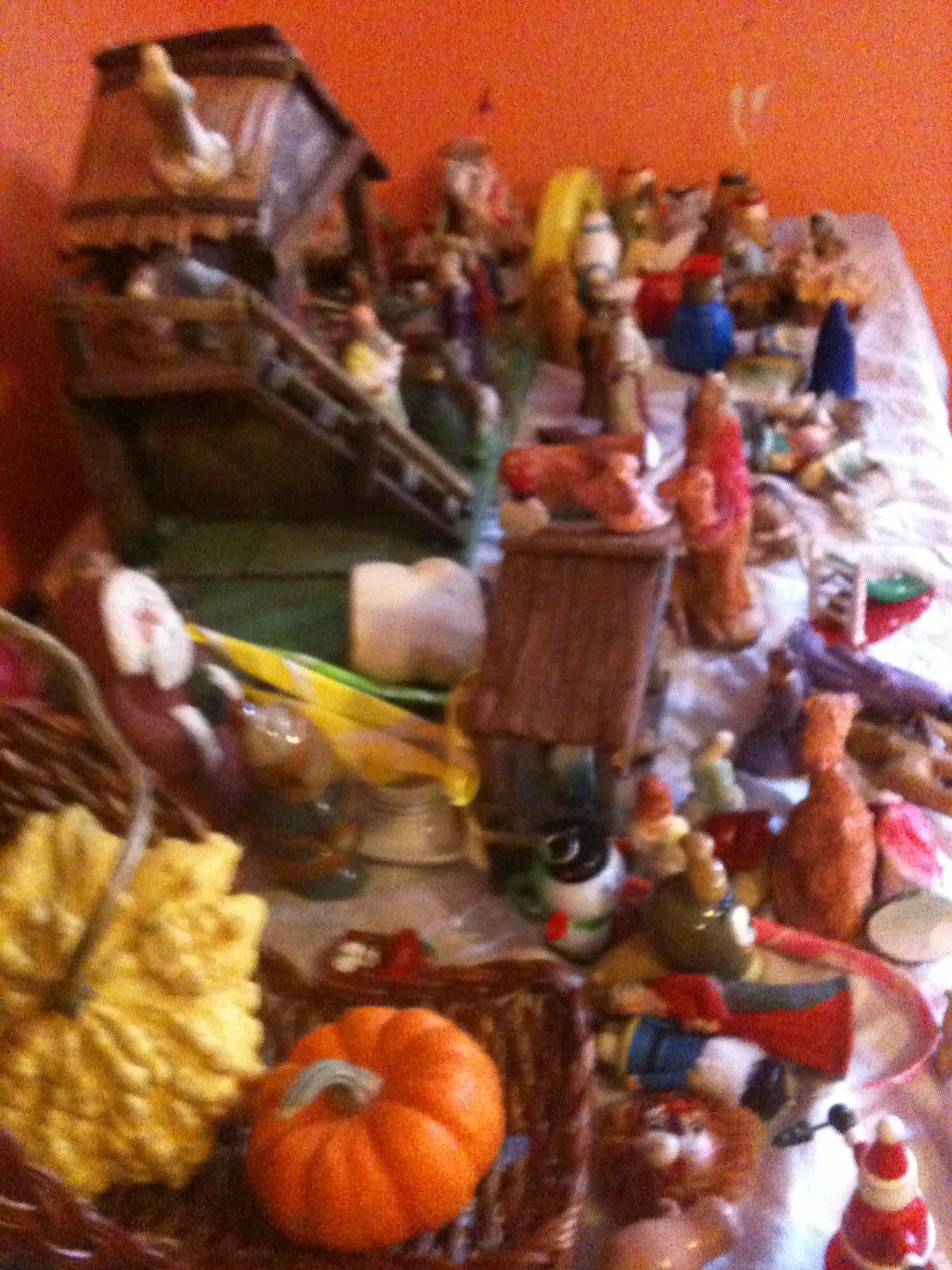
Kitbashed Creche


We got our Christmas on Sunday. In preparation, we set up our crèche on the top of the living room bureau Saturday night.
We have the most diverse, democratic crèche in Christendom, cobbled together from years of hand-me-downs and gifts. The pieces mingle merrily:
Half a dozen Marys
Slightly fewer Josephs
And Four Jesuses.
At least seven wise men
Not nearly so many shepherds
Even less sheep
Two nutcrackers
Two dogs (one of them Snoopy)
Three Santas
A lion
…and neither a partridge nor a pear tree.

Rock Gods #235: Adventures in Our Little Music Scene

By Artie Capshaw

Staircasing the Joint got their (not so great) name from playing a club two towns from here where the stage was a stairway to nowhere. “The second floor has been condemned or something,” recalls Pablo Pillock, the self-styled “SpanBrit Bandit” who runs this band like a drill squad sergeant. “This stairway was the stage. You stood on the steps and played.” And lest you’re imagining Newportian grandeur, “it was only maybe six feet wide, with a wall on each side. Cosy. Cool, I guess, but really…. Enclosed. Scary.”
Especially when he heard a sound on the other side of the door to nowhere. A knocking. “If someone, or something, wanted to be let in,” says Pillock, “ I wasn’t going to let that happen. I was full of justifications: It was an echo from the drums or bass in that small area. It was a storage closet for the bar up there. It was a demon from hell.”
“That’s when my hair started turning white. It happened right there.”
Adds a little depth to the band responsible for “Poptasticolorfuxplosion,” don’t it?

Pritty Ser Secco and Neuss Pastore at the Bullfinch; world music from scholars at the college on the hill.. Spring Up and The Cunningtons at Hamilton’s… The McSars and PipeLime, underground from down under, at D’ollaire’s for a reasonable price…