
By Artie Capshaw
For my money (not that we pay any—we’re on the list, don’tcha know), the best local opening act in town is Q (full name unknown), the barback and default roadie at the Bullfinch. No one runs a load-in like this guy. Time is money for him, and bands don’t tip the way the way other patrons might if he gets to spell one a bartender for a short spell. This guy may be at the bottom of the watering hole food chain, and spends most of his time moving stuff around in the cellar. So it’s a thrill when he comes out of his lair, hoisting each amp or gearbox in his inimitable style—up on his shoulder, clamped against his noggin like it’s a gigantic transistor radio. All hail Q—who’ll probably beat me up when he reads this, unless I specify right here and now that the praise is sincere. …
Candid Microphone Nite at the Bullfinch. Yeah, that’ll last… All-girl covers band The Housewives’ Protective League at Hamilton’s, sharing the bill with the members’ actual hubbies, posing this night as The Favorite Husbands but better known as Fitch Band… My True Story at D’ollaire’s, a rare tour, and reportedly a short. Luckily there are two opening acts: Scramby Amby and Rocky Fortune…
Category Archives: Uncategorized
For Tomorrow We May Die: Diary of a College Chum #163:
First broadcast, after 20 straight hours of set-up/party. First song: “Munga High.” (I was outvoted.)
Listening to… The Afro-Semitic Experience
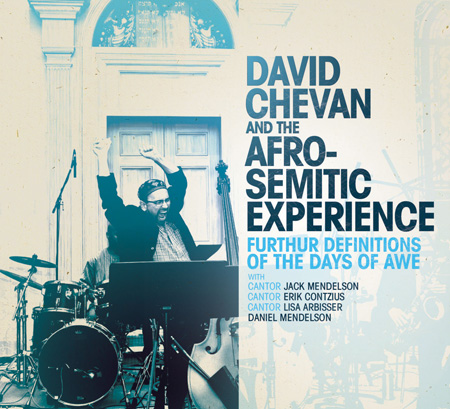
The Afro-Semitic Experience, Further Definitions of the Days of Awe
When I noticed this new album was called Further Definitions of the Days of Awe, I had to go listen again to The Days of Awe: Meditations for Selichot, Rosh Hashanah and Yom Kippu. That 2003 CD was billed as a solo project of Afro-Semitic Experience co-founder David Chevan’s 2003 but features the Afro-Semitic ensemble as well as Frank London. The yesterDays of Awe made me backtrack further to Afro-Semitic’s 2005 Plea for Peace and finally all the way home to Chevan and Warren Byrd’s This Is the Afro-Semitic Experience, the first album to use that name.
I could have dug out Chevan’s old Bassology recordings, where the roots for his musical cross-pollinations began. But I’d already done that last month, going on a Bassology binge without suspecting that a new Chevan disk was coming in the mail.
Not that everyone would (or should) do such dutiful scholarship.
But what’s most notable and remarkable about the Afro-Semitic Experience is how it gets you craving more. The band works with ritualized formats which suggest regular worship. I’m not Jewish, and don’t observe the Days of Awe which presage Yom Kippur. But I do observe the Afro-Semitic Experience.
Further Definitions of the Days of Awe is a live album, but the only difference between it and the studio records is that you can hear an audience cheering and applauding. Afro-Semitic albums always sound live. When cantors are enlisted as vocalists, they sound genuine and openly emotional, not studied or pristine. The band improvises readily and can really create a wall of sound if they wish, but also know when to politely sit aside and let Warren Byrd do a sweet, subdued, piano solo.
Afro-Semitic Experience has existed under that name for a decade now, and boasts the same five core members: Chevan on bass, Byrd on piano, Will Bartlett on various clarinets and saxophones and percussionists Alvin Carter Jr. (behind a drum kit) and Baba David Coleman (on congo drums). Trumpeter Frank London’s back for the New Haven one of the three concerts from which this recording was culled. (The others were in New York City and Greenfield, Mass., and all took place just before Rosh Hashanah last year.) One notable absence on this album is guitarist/violinist Stacy Philips, but you can’t have everything.
Actually, Afro-Semitic Experience suggests that maybe you can have everything. They enlighten, uplift and entertain. They respect traditions even while placing them in odd juxtapositions, and they improvise wildly. They bring in guest players from rabbinical chanters to electronicists, yet retain their key characteristics.
The effort it must take for the musicians to maintain such balance, grace and reverence while following their experimental instincts seems extraordinary. Miraculous, you could say. An interfaith blend of African rhythms, be-bop jazz and any Jewish music which can be applied, from klezmer to classical and, of course, cantorial. On the two-part “Ashrei,” beats get sprightly behind fervent wails. Then the horns kick in. “Viddui” opens with a sultry soul melody, almost a midnight groove. But instead of Marvin Gaye’s back-up singers, there’s a bunch of guys chanting in loose harmony, in Hebrew.
Describing the Afro-Semitic Experience always sounds funny to some people, like it’s some sort of forced conceptual joke. Which is why you must, to borrow a word from the band’s name, experience it. This CD, which shares one of the band’s own favorite rituals—backing Cantor Jack Mendelson at the midnight Selichot service at a synagogue in White Plains, New York—is an awesome place to start.
Literary Up: No Parkering
My friend and former New Haven Advocate colleague Colleen Van Tassell was in town last weekend, and I missed her. Had several chances to sup, and couldn’t make any of them. She lives in Pittsburgh, a city I have not been to in nearly a decade. This lack of contact has weighed heavily on my mind.
So I trawled through the basement and found a poem clipped from an old Vanity Fair magazine collection—the original Vanity Fair, of course, and since this concerns Colleen, the piece is by Dorothy Parker, of courser.
It’s titled Men: A Hate Song, and it begins:
I hate men.
They irritate me.
You can find the whole poem—and even an mp3 recitation of it—here. There’s a companion poem, “I Hate Women,” but it’s the Men one that Colleen and I used to coo about. It was pinned to my Advocate bulletin board for years.
Got to get out more. Got to plan a trip to Pittsburgh.
For Our Connecticut Readers
I hadn’t written anything about Robert Crotty dying. I was out of town when it was announced last month. He and I barely knew each other, hadn’t seen each other in years, came from different worlds.
And yet…
When I began writing the Music Notes column for the New Haven Advocate in 1991 and was dutifully doing my homework on who were the heavyweights in the local band scene, Crotty came up immediately. He’d been a fixture in blues bars for a while but was building a fresh following thanks to Mike Reichbart’s then-new Café Nine.
Crotty hosted a weekly blues jam at Café Nine for years, one which took on a different tone than the jazzier one he’d led in the 1980s at the Foundry Café in the Whitney/Audubon “arts district.”
When I started Band This Week, a companion column to Music Notes which profiled area musicians, Crotty was one my first interviews. I remember him being reluctant to talk, unlike his bandmate drummer “Mitch” Mitchell. He could be laid back and aloof onstage too, but there was no question who was in charge of the Robert Crotty Band. He commanded respect because nobody could question his natural talent, his fluid understanding of how to build a blues tune from an opening riff through a series of highs and lows into a forthright, soul-searching conclusion.
Crotty wasn’t cool or slick. He was Crotty.
This all came flooding back to me last week when I was at Café Nine and there was “Mitch” Mitchell. It was as if time had stood still, mainly because he was giving me grief for something I’d written about him 20 years ago. But he teared up a bit when talking about Crotty.
So did another guy there that night, ace bassist Bobo Lavorgna. Our chat wound round to a different local musical Bob, Bob Sheehan, who passed away a year or two ago. Like Crotty, Sheehan could be subdued and withdrawn at the bar, but never lacked confidence when playing, Onstage, they kept everything together—not as leaders but as masters. They hadn’t chosen their livelihoods. The music selected them.
I’m not the scene-dweller I used to be. I wonder if icons like Crotty ever appear in the present-day musical realm, or if that type is part of a vanished era. All I know is that I hadn’t seen Crotty play in years, yet I could feel the void.
Third Base!
Did the baseball season just end? It’s not that I lost interest, but the last few weeks wiped out the chances of one of the teams I follow (Red Sox) and did nothing to erode the extraordinary lead held by my other favorite (Tigers). It was combination of not wanting to look and not having to.
And it’s still that way in the post-season. The Red Sox are completely out of it—not struggling, not weakened, not braced for a comeback, simply not there at all. And Tigers vs. Yankees? I’m scared to look. Crossing my fingers and looking the other way.
Rock Gods #209: Adventures in Our Little Music Scene
A miles- long traffic jam between our town and a certain big club in a certain major city. Two bands from this area en route, both on the bill, both hoping that if they can’t get there, least the other band might so “out of town nite” at the historic venue wouldn’t be a total loss.
” forty five minutes without moving, and we get out and wander around the highway,” recalls Paul straw of the sedents. “Just a few rows up, there’s the peripatetics’ van.”
The bands joined forces and honed a strategy. The peripats had a bike in their van, so Paul, a messenger by trade, took it and rode it to the nearest transit line, a guitar strapped to his back. A Paul revere of pop, he rides into town (back on the bike, having begged a transit guy to let him bring it on the train even though it wasn’t off peak), bellowing “The C-dents and The Peripatetics are coming! The C-dents and The Peripatetics are coming! At least that’s how they tell it.
Paul did a solo set, the bandmates arrived and traded of spins for the rest of the night. There was even a decent sized audience in the room, and a couple pod people who claimed to be agents.
Ride home? Don’t ask.
Bullfinch closed tonight for lack of cutting-edge bands. They’re varnishing the floors in order to catch some… Bold Venture and Diamond Drama at Hamilton’s, slinging covers… The Hashknife Hartleys and Hawaii Calls at D’ollaire’s, darlings…
For Tomorrow We May Die: Diary of a College Chum #162:
Turns out pirate radio stations aren’t all that illegal anymore; kind of kills the thrill, but all the equipment’s in the living room so we’re going for it.
Listening to… Fanzine
Fanzine, “Roman Holiday”
This early single from the forthcoming album My Stupid Brain begins like some bargain-bin discovery from the great age of faceless ‘70s riff-rock, then swells with woo-oo-oos and decidedly non-stadium vocals. The rawk turns human before your very ears.
Literary Up: Not Dean Koontz’ Frankenstein
Dean Koontz’s Frankenstein: Prodigal Son, Volume Two
Adapted by Chuck Dixon. Illustrated by Scott Cohn and Tim Seeley. Colors by Ale Starlin. Lettering and Collection Design by Bill Tortolini. Collection Cover by Brett Booth.
Koontz gets top billing in the comics adaptation, both as part of the title and just below it.
This version was originally issued in multiple-issue comics form, Volume 2 being the second collection of those individual comics. So the adaptation is already kind of stop/start and repetitive. But it also just has a different temperament and tempo from the novel version which begat it. To complicate matters, that novel grew from a 1994 TV miniseries project which Koontz left over creative differences with the USA network but which contains some of the same characters.
Koontz’s Prodigal Son novel (which originally bore a shared credit with Kevin J. Anderson) is easily the strongest of the three versions, though there’s no reason why the TV or comics series couldn’t have surpassed it. In all three, the story of a modern Prometheus is mapped out for maximum impact, intersecting with a slew of serial killings and the profound personal problems of the principal characters. The story is a police procedural, an insane-killer caper, a science fiction speculation, a noir thriller and an unhinged horror squeamfest all in one.
The illustrations in the graphic novel match the snappy sensationalism of its own comics-concise text, but neither captures the mood of Koontz’s sprawling and novel. Instead of the darkness that fills the book, there’s a constant glare.
Koontz’s books have lots of downtime built into them, where you begin to relate to his characters as humans because of the way they chat amiably with each other and go home to bed occasionally. There’s a few pages of car chat in the comic version, but it’s expositional rather than emotional. Having the structure streamlined shows you how much Dean Koontz has on the ball.