
HERE, pastpresentfuture. Great thing to stumble across at 1 in the morning. Hearkens back to the days of truly experimental prog rock, and all the more interesting for being primarily concocted by a duo—twin brothers at that. HERE originally hails from Connecticut, but I’m sure I never saw them live. They play The Space in Hamden on Oct 1, a great opportunity to see how they can pull off intricate songs like these. “the running, climbing, swimming, flying” is a staggering style collage encompassing all the activities of its title, unified by tireless drums and guitars.
The Space show will feature the brothers Mims—Dan Mims and Matt Mims, now ensconced in Brooklyn—plus special guest bassist Ari Sadowitz of New Haven’s own The Smyrk (for whom he played guitar). Three current Connecticut acts fill out the bill: Bread Pilot and Reaching Moon (both from Southbury) and Oculesics (from West Haven), plus Chasing Suns from Cape Cod, Mass.
Category Archives: Uncategorized
Literary Up: Zing Along With Mitch
Mitch Miller by Edgar Lee Masters.
Edgar Lee Masters should be remembered for lots more than Spoon River Anthology. Mitch Miller is a self-conscious 1920 modern-lit take on Hamlet and Tom Sawyer. The book’s hero had read both Twain and Shakespeare, and regularly compares his own adventures to theirs. He even has similar troubles with his parents and gets caught up in a murder mystery and courtroom case.
Sounds like a ripping boy’s adventure yarn, or perhaps a Dickensian potboiler. But all Masters’ work, from his poetry to his plays to his novels to his biographies of Abraham Lincoln (another figure frequently referenced in Mitch Miller), Walt Whitman and Twain, is imbued with strong political and social themes. Masters practiced law with Clarence Darrow. He defended the underclass and decried the insensitivity of governments. His books allow the downtrodden to complain. In Spoon River, he even allows ghosts to bitch and moan from the afterlife.
In this edition of Mitch Miller, Edgar Lee Masters’ concerns for the most vulnerable members of society are underscored by his choice of illustrator the novel: John Sloan, the celebrated “Ashcan artist” who brought social realism to American art museums. During the decade before Mitch Miller was published in 1920, Sloan had been the art editor of The Masses, the set designer for the The Paterson Strike Pageant, and a participant in the famed 1913 Armory Show.
Mitch Miller is written in a first-person vernacular, narrated by the titular Mitch’s pal Skeet. Mitch likens himself to Hamlet, and deems Skeet his Horatio. The Shakespeare allegories in the book are fascinating; it’s like that scene in The Wire where a chess game is compared to selling drugs on the streets of Baltimore.
It’s also got this observation, as filtered through Skeet:
About this time I was about a third through readin’ the Bible to earn that five dollars that grandma had promised me. And Mitch asked me what I though, and I said I didn’t understand it much; but in parts it was as wonderful as any book. And Mitch says, “Do you know what the Bible is?” “No, I says; “what is it?” “Why,” he says, “the Bible is the ‘Tom Sawyer’ of grown folks. I know that now; so I don’t have to go through the trouble of findin’ it out after I’m grown up and depended upon it for a long while. There’s the sky and the earth, and there are folks, and we’re more or less real to each other, and there’s something back of it. But I believe when you die, you’re asleep—sound asleep—I almost know it. And why we should wake up a bit and then go to sleep forever is more than my pa knows or any person in the world knows.”
Mitch scared me with his talk. He was so earnest and solemn and seemed so sure.
For Our Connecticut Readers
In the final weeks of school last spring, the school bus was held up on the very day Mabel’s class was off on a day-long field trip to the aquarium in Norwich, with me as chaperone. We could see the turmoil; a different bus had broken down just down the street from our stop and was blocking every other bus on the route.
So I called a cab. First time we’d ever all had to take a cab to school.
So I rattled off the name of the school to the driver. “Do you know Jepson?”
He replied “I know Jepson. I mean, I didn’ t know Benjamin Jepson, I’m not that old. But I know Jepson school.”
That was my introduction to Al the PLR cab driver. I knew him from his occasional calls in to the PLR morning show, of course. But I wouldn’t have placed him as our cab driver if he hadn’t told me flat out that he was “Al, the PLR cab driver.” Because that’s the kind of amiable, loquacious guy Al the PLR cab driver is. He knew that Benjamin Jepson was a well-known music teacher in town, nearly a century and a half ago.
All I know is that Al soothed our hectic morning by being so friendly, so chatty and so confident that he’d get us to the field trip bus in time.
We pulled up with moments to spare, and Al idled while I rushed Sally into her class and Mabel stalled her teacher.
It’s the same attitude he brings to the airwaves in his cameo appearances on the Chaz & AJ show. Nice to know there are cab drivers out there who love to be cab drivers, who are born—driven, you could say—to be cab drivers, and who are there when you need them.
More Singles from the Basement
Christopher Arnott continues to footnote his 45s
The Five Satins, “In the Still of the Nite.” We drive right past St. Bernadette’s Church in New Haven several times a week when bringing our children to school.
Girls Against Boys, Bulletproof Cupid/ Sharkmeat. Incisive dissection of ‘90s pop through dark filters of volume and echo. Not casually experimental, not cynical. Masterful, throbbing with theory, understated yet almost too intense to hear all at once.
The Monkees, D.W. Washburn/It’s Nice to Be With You. Arguably the Monkees weakest-ever 45, yet dig who’s involved. The A-side’s by Lieber & Stoller, the B-side’s by Jerry Goldstein of The Strangeloves and The Angels, and both were arranged by jazz/pop great Shorty Rogers. (Best Monkees single ever? Undoubtedly I’m a Believer/Steppin’ Stone).
The Hues Corporation, Rock the Boat. The song credited with starting the disco movement. Has anyone noticed that the flip side is called “All Goin’ Down Together”? That’s some boat they’re rocking. Both songs emanate from the suggestively titled album Freedom for the Stallion.
The Magnetic Fields, “All the Umbrellas in London”/”Rats in the Garbage of the Western World.” I didn’t discover Magnetic Fields until 1994 or so, when they’d been around a few years. But I caught up quick. If I’d still been living in Boston when they formed, I believe I would have been a charter member of their fan club—word travelled fast among my friends about a band like that. As it was, I first saw them live at Yale’s GPSCY Bar, at a near-empty show sponsored by the now-defunct Yale rock zine Nadine. (If memory serves, and it might not, I think the other bands on the bill were Helium and Polvo.) At the time, there was no other band you could compare Magnetic Fields to, except maybe a certain sliver of John Cale’s career. 69 Love Songs came five years later, and then everybody knew Stephin Merritt. This single was released when Magnetic Fields still felt like a band—a Boston band, yet—and not just a songwriter who called up his musician friends when he wanted to record or tour.
Rock Gods #211: Adventures in Our Little Music Scene
This was the set list for the He Who Gets Slapped show Thursday at the Bullfinch:

How d’you think it turned out? Magic. Sheer magic. Assuming that Sheer Magic is a brand of rum.
The Rakitins and Lulu Cough at the Bullfinch… Rasta Covsky, Russian Reggae, at D’ollaire’s, with Corporal’s Widow… Hamilton’s has a private party we’ll tell you about once the smoke clears…
For Tomorrow We May Die: Diary of a College Chum #164:
The theater gang next door wants to shanghai our station.
Listening to…
Gem Club, Breakers. Released Sept. 27 on Hardly Art Records
At first look, I thought Gem Club resembled Connecticut’s own The Procedure Club—withdrawn female vocalist and scruffy male instrumentalist. But Gem Club doesn’t race around like Procedure Club or other duos. Their sound is mystical and moody and takes its time in excitedly risky ways. Whispers are echoed, tinkling bells carry the melody away from the strings and piano. Besides, this is a trio: leader/pianist Christopher Barnes, cellist Kristen Drymala and singer Ieva Berberian.
The music could score a tragic Swedish drama, a cold walk on the beach. But contemplative moments shine through.
Literary Up: Could It Get Any Gordimer?
Here’s how the reliably lurid Signet paperback people were marketing Nadine Gordimer in 1956:
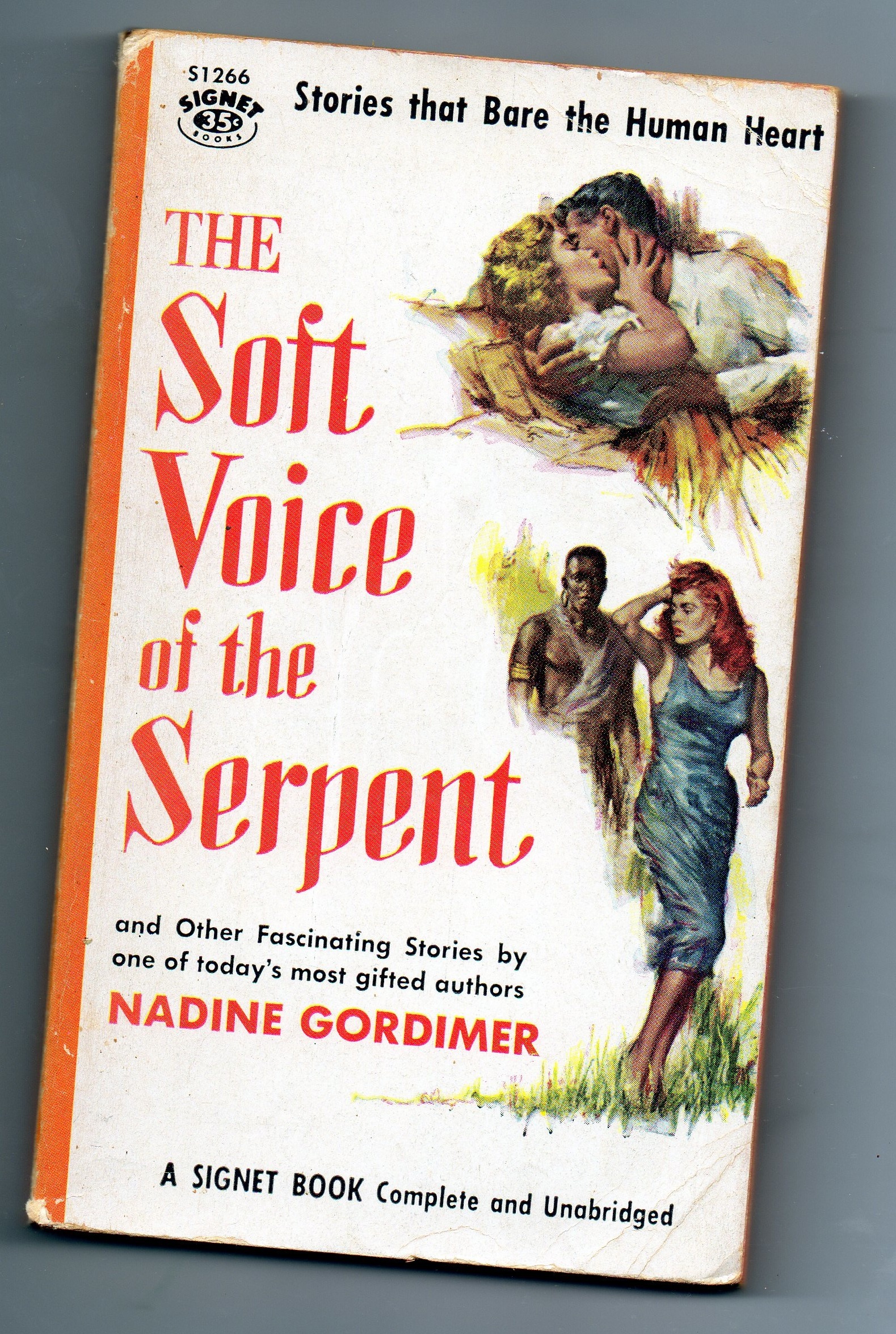
Quite a change from 20 years later:

For Our Connecticut Readers: Fellowshift
After the third time I’d directed someone on Dwight Street to 48 Howe Street (“You’re on the wrong street!”), I finally got it. Fellowship Place, our friendly neighbor from down the block, has moved its so-called “Clubhouse program” to a new location while its longterm headquarters on Elm Street between Dwight Street and University Place is undergoing six months worth of renovations.
Fellowship, which calls itself “a supportive community fostering mental health,” runs several residential houses for its clients, but for many of them a central gathering place can be as crucial as living quarters. Fellowship’s “Social Programming” shifted to 48 Howe on Sept. 15.
Fellowship Place is celebrating “50 Years of Caring” this year. It’s easy to get run down and need a change of scenery when you turn 50.
Best of luck in your new location. Howe Fellow, well met!
Faygo East, Young Man
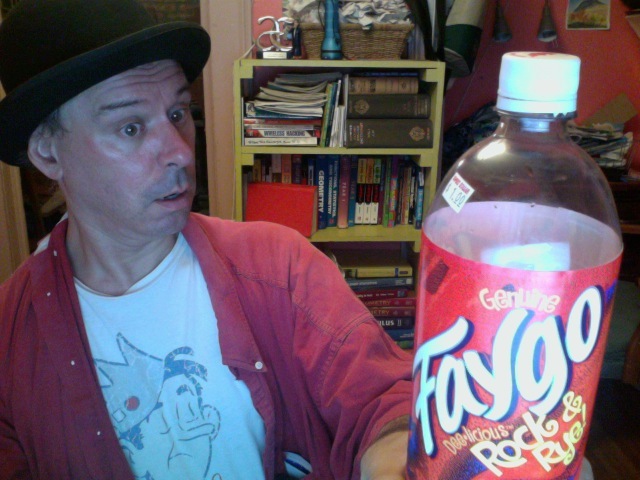
Kathleen and Mabel went shopping at the Family Dollar store, and when they returned they said they had a surprise for me.
More like a miracle. The miracle of nectar being stolen from the gods on Mount Olympus. Or, in this case, Detroit Michigan.
They were brandishing a one-liter bottle of Faygo Rock & Rye soda pop, an elixir which I know from my own extensive safaris into supermarkets to be available only in the Midwest.
Having been born in Iowa City and spent 20 summers in Michigan, I’m a soda pop snob. I’ve had the best, and the best of the best are:
1. Vernor’s.
2. Faygo Rock & Rye.
(After that, Connecticut can have a turn. Insert your favorite Foxon Park soda into slot number three.)
Just as Vernor’s is too good, too distinctive, to be referred to merely as “ginger ale”—it’s like real Champagne versus “sparkling wine”—Rock & Rye rises above all other products which bear the label “cream soda.” The fact that they’re not easily gotten in most of the United States only makes them tastier.
I’m glad Kathleen and Mabel found the Faygo at the dollar store first, because if I’d seen Rock & Rye on a New England supermarket shelf myself I would have fainted.
So what does this all mean? Will Rock & Rye now be regularly available in my home state, meaning I don’t have to pay shipping fees for special delivery from online soda pop purveyors? (Went to Stop & Shop today just to check if they have Rock & Rye too. They don’t.) Or was this some extraordinary carbonated fluke?
In either case, my world has been rocked. And ryed.